
Skip to content
Eldon LynchThe Lumberyard Counter Book

A lumberyard counter handbook

Read the tag before you load the truck

Most lumber mistakes happen at the rack, not at the saw. I framed houses in southern Indiana for forty years and now work the counter at a small-town lumberyard three mornings a week. This book shows you how to read a board, decode a treated-lumber tag, read a plywood stamp, match the fastener to the wood, and give a fence or shed a base that lets water leave.

The Final Counter Card: ten questions to answer before you pay

PDF e-book · 7-day money-back guarantee

67 pages · 8 chapters · 17 figures · 1 ten-question counter card

The Lumberyard Counter Book

The Lumberyard Counter Book · First Edition · 2026 · PDF e-book · 67 pages · 8 chapters

67Pages
8Chapters
17Figures
$19Your order

At the counter

A neat list can still be the wrong list

Every week I watch good people buy the wrong thing for a perfectly good reason. The trouble is rarely the lumber. It is that nobody told them what to ask for, or what the tag meant.

  • Your list says six 2-by-6s, two sheets of plywood, and a box of screws. It does not say what any of them has to do.
  • The tag says UC3B or UC4A, and you cannot tell which one belongs on a porch and which one goes in the ground.
  • A screw looks right in the bin, then rusts at the threads inside treated wood where you cannot see it.
  • A fence that looked square at noon leans by spring, because the trouble started below the grass.
Get the book $19

PDF e-book · 7-day money-back guarantee

The book

The Lumberyard Counter Book

The Lumberyard Counter Book

The book

The Lumberyard Counter Book

The Plainspoken Handbook for Boards, Panels, Fasteners, Fences, and Sheds

The Final Counter Card: ten plain questions that make the material, the treatment, the fastener and the drainage visible before you pay for any of them.

The Lumberyard Counter Book is a 67-page, 8-chapter PDF e-book. It follows the order you actually shop: describe the job, read the board, read the treatment tag, read the plywood stamp, choose the fastener, set a fence post, prepare a shed base, then take one last walk from rack to finished job. It has 17 figures, comparison tables, step-by-step sequences and checklists. It is about materials and bases, not a set of building plans.

Chapters

  1. Start With the Job, Not the Shopping List
  2. How to Read a Board Before You Buy It
  3. Treated Lumber Without the Alphabet Fog
  4. Plywood Stamps, Faces, Plies, and Span Ratings
  5. Fasteners That Belong With the Material
  6. A Fence Begins Below the Grass
  7. Give the Shed a Dry, Square Place to Stand
  8. The Final Walk From Rack to Finished Job
Get the book $19

PDF e-book · 7-day money-back guarantee

Where to start

Start with the decision in front of you

Each of these chapters stands on its own. Pick the one that matches the job you are about to price, then come back for the rest.

  1. Treated Lumber Without the Alphabet Fog

    UC3B, UC4A and UC4B describe how wet a board will get, not how good it is. Learn to read the tag, ask about retention, and treat fresh cuts as a new exposure.

  2. A Fence Begins Below the Grass

    Choose ground-contact posts, give water somewhere to go, backfill in tamped lifts, and keep the grass line visible. The chapter ends with a six-step fence-base sequence.

  3. Give the Shed a Dry, Square Place to Stand

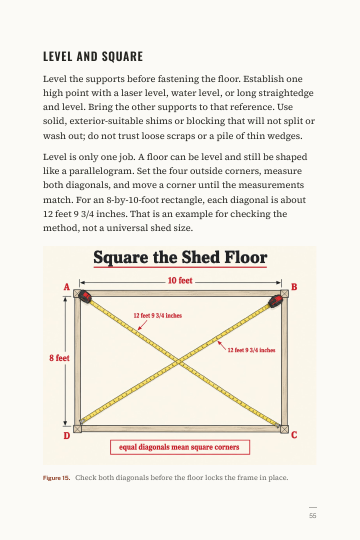
    Water first, then bearing, then level and square. It covers gravel pads, skids and blocks, checking both diagonals, protecting cut ends, and leaving the underside inspectable.

Get the book $19

PDF e-book · 7-day money-back guarantee

Look inside

Open a page and read it

Here are four real pages from the book. They show the plain style, the tables and the figures. Tap one to enlarge it.

67 pages · 8 chapters · 17 figures · 1 ten-question counter card

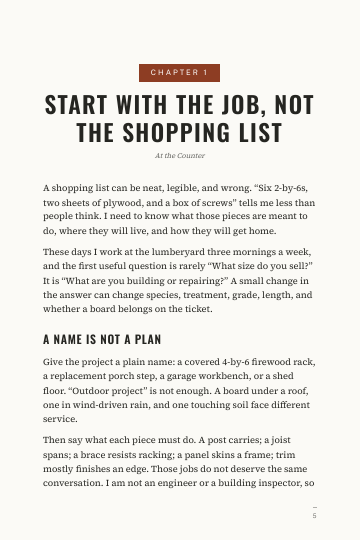
Page 5 — Start With the Job, Not the Shopping List
Page 5 — Start With the Job, Not the Shopping List ↗
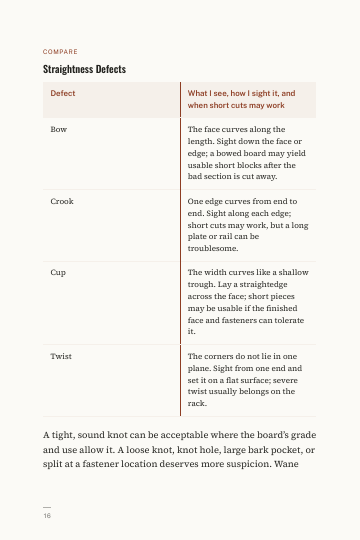
Page 16 — Straightness defects: bow, crook, cup and twist
Page 16 — Straightness defects: bow, crook, cup and twist ↗
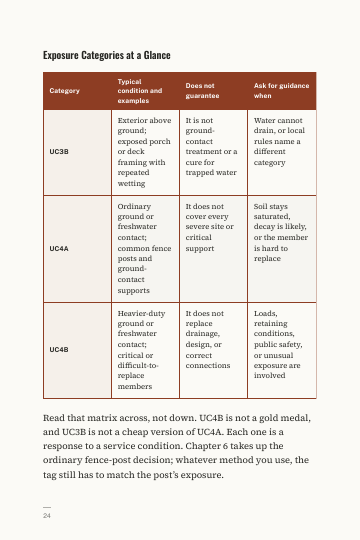
Page 24 — Exposure categories at a glance
Page 24 — Exposure categories at a glance ↗
Page 55 — Level and square: check both diagonals
Page 55 — Level and square: check both diagonals ↗
Get the book $19

PDF e-book · 7-day money-back guarantee

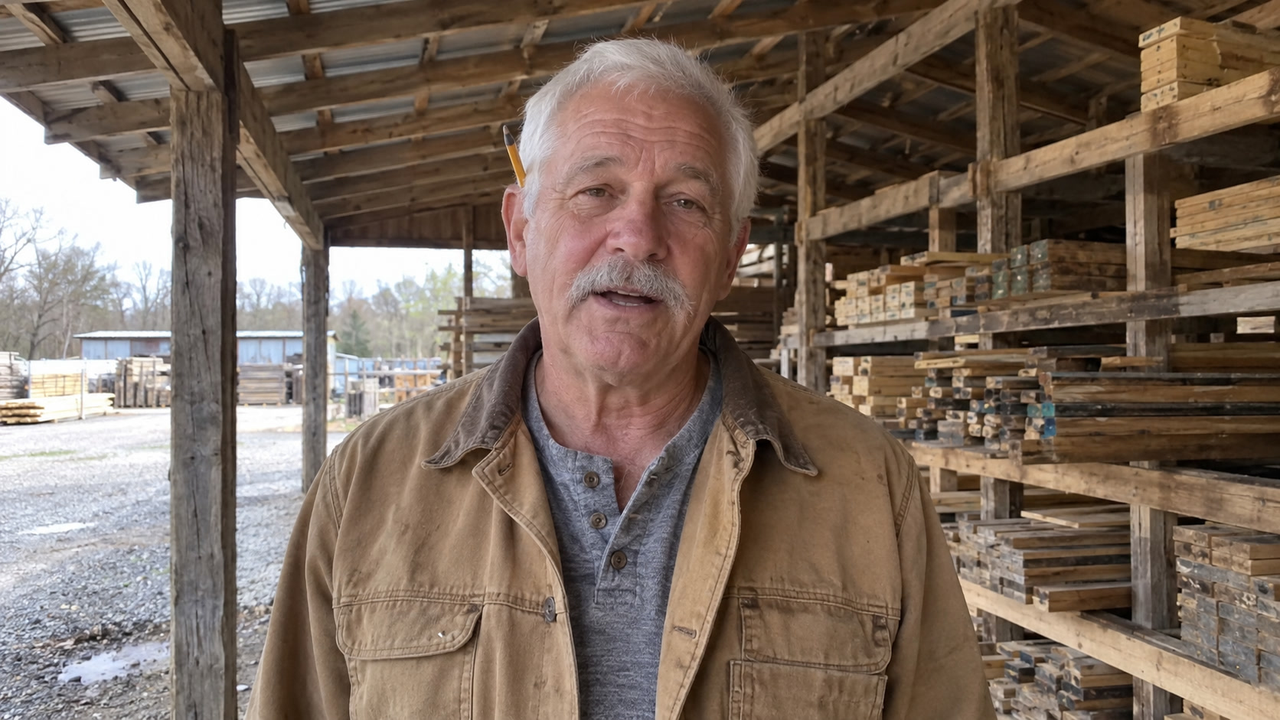
Eldon Lynch

From the author

From the lumberyard counter

I framed houses in southern Indiana for forty years, and I still work three mornings a week at a small-town lumberyard. I have nailed thousands of sheathing sheets onto roofs and walls, built porches and fences, and helped a lot of people turn a rough idea into a material list that holds together.

My first foreman, Orville Tackett, kept a notebook of every callback, and it taught me that a board saved at the rack costs less than a board replaced behind finished work. My grandfather Amos showed me a fence post set on creek gravel and a tamping bar. I have also made the mistakes in this book myself: topsoil backfill that rotted garden-fence posts, and skid ends I forgot to treat.

I am a carpenter and a counter man. I am not an engineer, and I am not a building inspector. Where a stamped plan, a permit office or the manufacturer's literature says something different, they win.

— Eldon Lynch

Get the book $19

PDF e-book · 7-day money-back guarantee

Is it for you?

Who I wrote this for

This is for you if

  • You are about to buy lumber, plywood or fasteners for a porch, fence, workbench, shed floor or similar home project and want to ask the right questions.
  • You want the tag, the stamp and the board itself explained in plain words, one term at a time.
  • You like checklists, comparison tables and step-by-step sequences you can take to the yard.

This is not for you if

  • You want shed or fence building plans, cut lists with drawings, or a full step-by-step build. This book covers materials and bases, not complete plans.
  • You need a structural design, a load calculation or a permit answer. Those belong to an engineer or your local building office.
Get the book $19

PDF e-book · 7-day money-back guarantee

What you get

The complete book

The Lumberyard Counter Book is a PDF e-book with 8 chapters on job planning, reading boards, treated-lumber tags, plywood stamps, fasteners, fence bases and shed bases. It gives you the whole counter conversation in order, with 17 figures, tables, step-by-step sequences and the ten-question Final Counter Card at the end.

The Lumberyard Counter Book

Your order

The Lumberyard Counter Book

$19

The Lumberyard Counter Book · First Edition · 2026 · PDF e-book · 67 pages · 8 chapters

67 pages · 8 chapters · 17 figures · 1 ten-question counter card

  • The Lumberyard Counter Book · 67 pages · PDF
  • 17 figures, comparison tables and checklists
  • 7-day money-back guarantee
Get the book $19

7-day money-back guarantee. Questions or a refund? Just reply to the purchase email you got from Hotmart. A real person answers.

More from Eldon

Complete the set

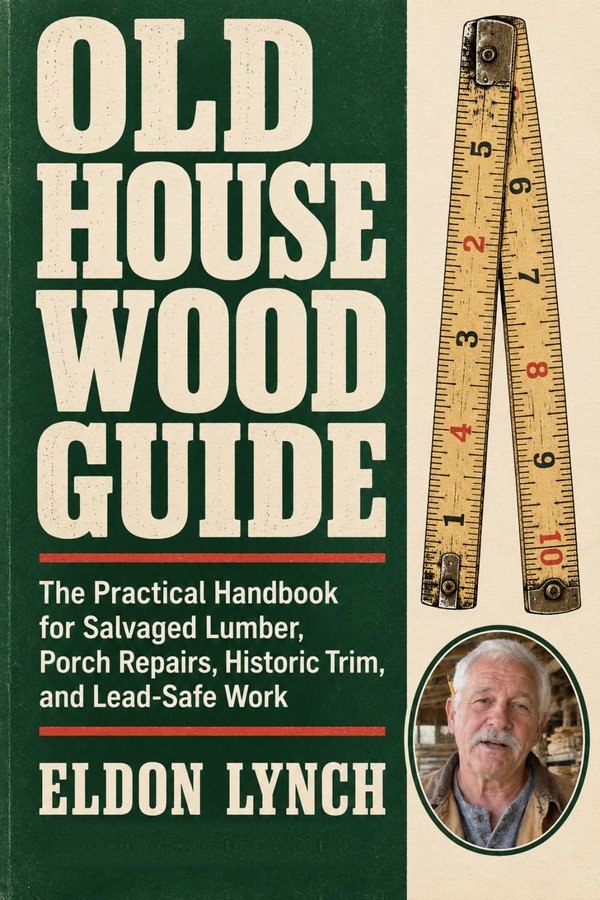
Old House Wood Guide

Companion book

Old House Wood Guide

The practical handbook for salvaged lumber, porch repairs, historic trim and lead-safe work. Seven chapters take you from reading old wood and how old paint changes the job, through taking it apart without ruining it, repairing a porch from the water back, and patching, splicing or replacing trim.

The Lumberyard Counter Book

Questions

How is the book organized?

Eight chapters in shopping order: describe the job, read the board, decode treated-lumber tags, read plywood stamps, match fasteners, set a fence post, prepare a shed base, and take a final walk from rack to finished job.

Do I need building experience to use it?

No. It is written for ordinary homeowners and weekend builders. Every term, from nominal size to retention, is explained once in plain words.

Does it include shed or fence plans?

No. It covers the material choices, the ground-line work for a fence post and the base for a small shed, with 17 figures. It is not a plan set and has no full cut lists.

What do UC3B, UC4A and UC4B mean?

They are Use Categories for treated lumber. UC3B is generally above-ground exterior use, UC4A is ordinary ground contact, and UC4B is heavier-duty ground contact. Chapter 3 explains how to read them and why they are not a quality ladder.

Does it replace an engineer or a permit check?

No. I am a carpenter and counter man, not an engineer or a building inspector. The book tells you when to stop and ask your local building office, a design professional or the manufacturer.

Why buy a book when free videos exist?

A video shows one job. This book keeps the tag, the stamp, the fastener and the drainage in one ordered sequence you can carry to the yard and tick off.

What format is it?

A 67-page PDF e-book. It opens on a phone, tablet or computer, and you can print it.

What about delivery and refunds?

Hotmart emails you the download link after you pay, and the page you land on after paying also has the PDF. Every order has a 7-day money-back guarantee. Questions or a refund? Just reply to the purchase email you got from Hotmart. A real person answers.

Get the book $19

PDF e-book · 7-day money-back guarantee

Read the tag. Then load the truck.

Take the book to the yard, the workbench or the back fence. Answer the ten questions on the Final Counter Card before you pay, and the job gets cheaper to get right.

Get the book $19

PDF e-book · 7-day money-back guarantee